“There’s this very deep connection with our inner-opening, with our own well-being, and the well-being and connection to the natural world around us.” – Jack Kornfield
When my teacher, Ajahn Chah—a forest monk and meditation master from Thailand—came for his first visit to the U.S, we picked him up from the airport in Boston in a big van to drive him to our center in Barre Mass. We went down Memorial Drive past MIT and the towers of Harvard, showing him the Boston university sites. Then we got on the Mass Turnpike. We drove for 20 minutes or so until we got outside the belt of the city, and we started to pass not just fields, but woods.
As we drove along his eyes got bigger and bigger. He said, “What are these woods? What are these forests? Pull over!” So we pulled over on the turnpike, and he got out and walked out to the fence at the edge of the road. There were all the pines, maples and oaks. His eyes were wide as he exclaimed, “Wow! Who lives in these forests? What does it smell like in these forests? What kind of animals? Are there bears? How about lions?” Then he turned to me and asked, “How far do these forests go?” I said, “Oh, maybe 1,000 miles north up to the Arctic…they go a really long way.” He got really excited. Forget Harvard and MIT, let’s go for the real deal!
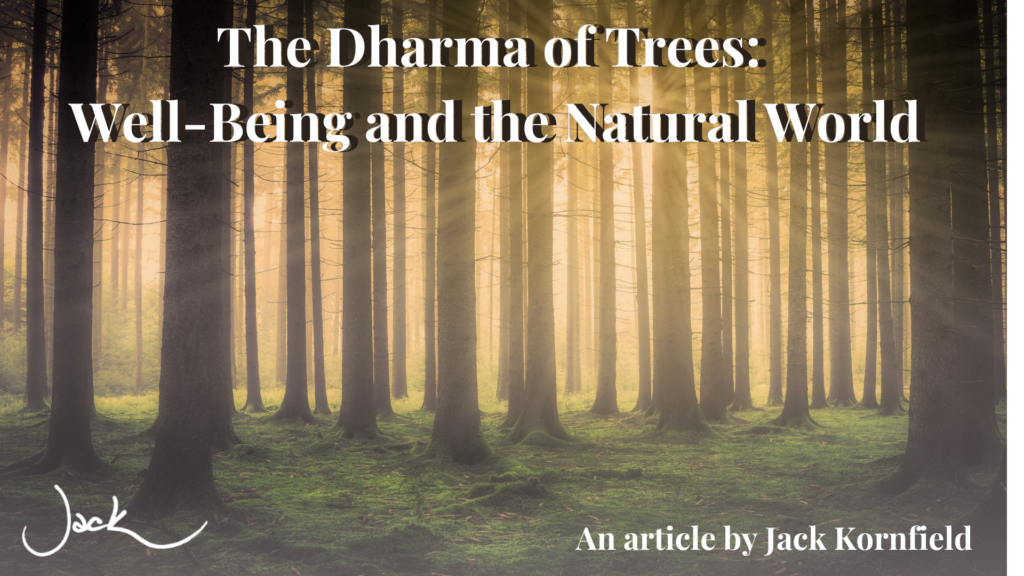
If you look at the Buddhist tradition archetypically, the Buddha was born under a tree, he practiced his meditation under a tree, he got enlightened under the Bodhi Tree, he taught and lived under the trees for years, and then he laid beneath two beautiful Sal Trees which burst into flowers upon his death, as the story goes. There’s this very deep connection with our inner-opening, with our own well-being, and the well-being and connection to the natural world around us.
I remember going to visit another great forest master, Ajahn Buddhadasa, after I had been teaching for a few years. I said to him, “Ajahn Buddhadasa, students in America have a lot of trouble with self-compassion. Not to speak of kindness for the people around them, but it’s hard especially for themselves. There’s so much self-judgment, criticism, shame, trauma, etc. Do you have any advice for us?” He said, “Yes, it’s simple – take them out into the woods and forest, and the great trees and the rivers. Bring them into the natural world and teach them the meditations of loving kindness. After they’ve been out there for a while, they’ll get better.” It was that simple for him.
This article is a transcribed excerpt from my new course: Transform Your Life Through Jack Kornfield’s Most Powerful Stories: A 10 Hour Journey